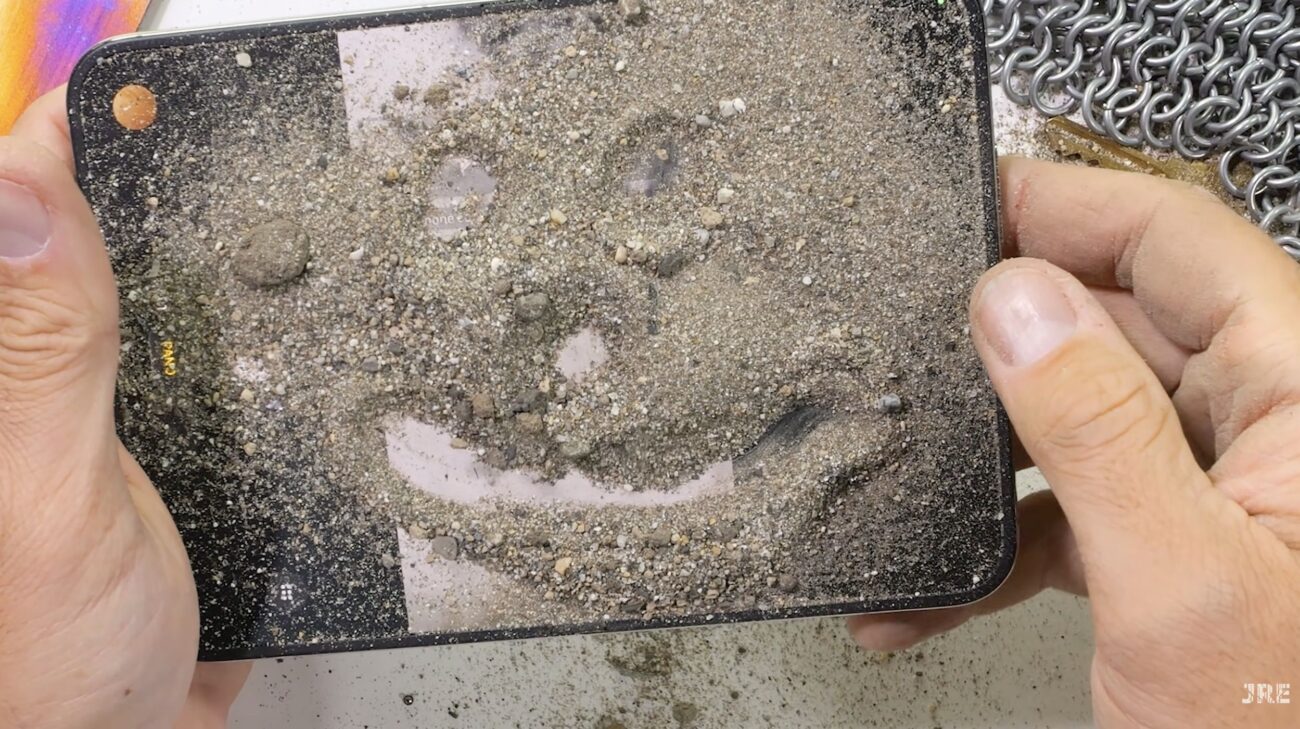
Everyone is talking about the crack. Whether it’s durability concerns, folding stress, or another round of “foldables aren’t ready” headlines, the controversy has already been covered to death. But after spending time with display models, I left thinking the crack might not even be the iPhone Duo’s biggest issue. The real problem is that Apple appears to have built a foldable phone without fully embracing what makes foldable phones useful (or cool) in the first place.
The iCrack Controversy: Fold At Your Own Risk

The durability debate is impossible to ignore.
A folding display introduces more failure points than a traditional slab phone, and early reports have already raised concerns.
Whether the issue proves widespread or not, Apple now faces the same challenge every foldable manufacturer has faced since day one: convincing buyers that a screen designed to bend thousands of times can be trusted.
But here’s the thing: durability will improve. It always does. Software decisions tend to stick around much longer.
A Foldable That Thinks It’s Just a Bigger iPhone
After seeing and using the Duo in person, I expected Apple to bring at least some of the multitasking power from iPadOS. Instead, the device feels like a regular iPhone stretched across a larger display. Despite having a tablet-sized canvas when unfolded, multitasking appears surprisingly limited.
Users are effectively restricted to two apps side-by-side, with little flexibility to resize windows or create more advanced layouts. Expanding an app simply returns it to fullscreen. There are no floating windows, configurable app groups, or the sort of dynamic workspace that has become common elsewhere in the foldable market.
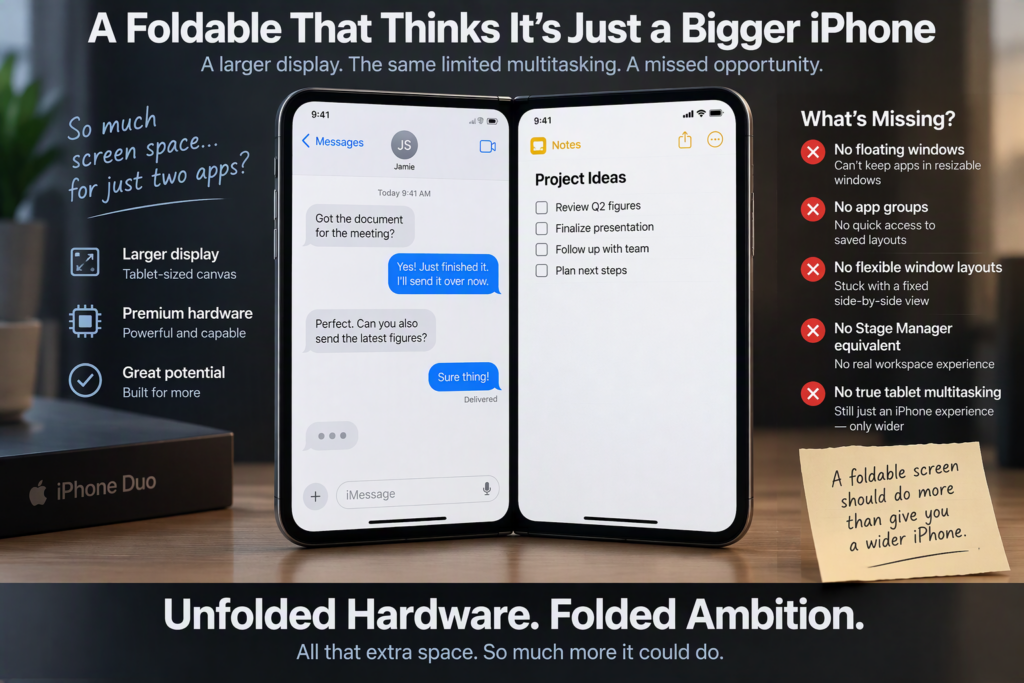
Even entering split-screen mode feels unnecessarily cumbersome (at least to me), requiring users to either start from Recents or long-press an app before selecting a multitasking option. To be fair, I recently came across a particularly enthusiastic Apple fan, or as some would jokingly call an “iSheep,” arguing that the Duo’s multitasking is being unfairly criticized. And honestly, they weren’t entirely wrong.
Having two apps visible at once genuinely makes common tasks easier. Copying and pasting information, viewing one-time passcodes, handling two-factor authentication, referencing notes while filling out a form, or comparing information between apps all become much more convenient than constantly jumping back and forth on a traditional iPhone.
The problem is not that Apple’s multitasking is useless. The problem is that Apple appears to stop there. For a device built around the promise of a larger screen, the software rarely takes advantage of that extra space. The Duo solves the annoyance of app-switching, but it rarely feels like a productivity device. Instead of feeling like a pocket-sized tablet, it often feels like two iPhones sharing a display.
Competitors Solved This Years Ago
What makes Apple’s approach even harder to understand is that the company isn’t entering a new category. Samsung spent years refining foldable multitasking. Google brought desktop-inspired app management to the Pixel Fold. Motorola offers competent split-screen functionality. Oppo and OnePlus arguably set the standard, with intuitive multitasking systems that allow users to quickly switch among multiple apps, create app pairs, manage floating windows, and make full use of the larger display.
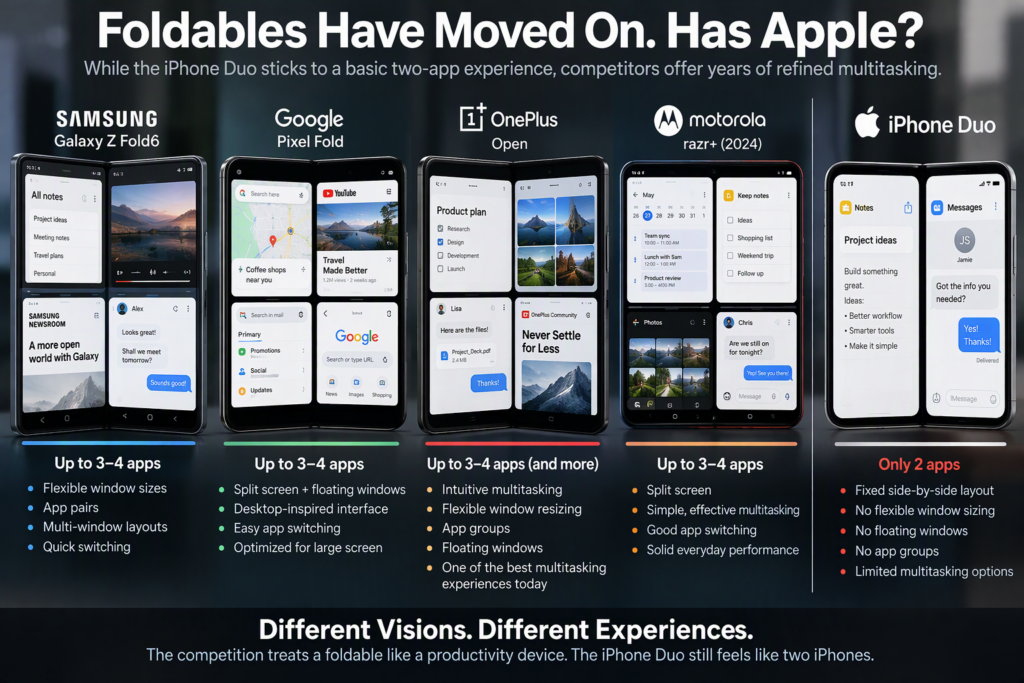
Many foldables can comfortably juggle three or even four apps at once. Creating app groups is simple. Rearranging windows is intuitive. Moving between multitasking layouts often feels as natural as using a desktop operating system. Apple had the benefit of watching an entire industry experiment, fail, and improve. Instead of learning from a decade of evolution, the Duo feels strangely similar to the earliest foldables that treated the inside screen as little more than an enlarged phone display.
Apple Already Has the Solution
The most frustrating part is that Apple has already built excellent multitasking software.
It’s called iPadOS.
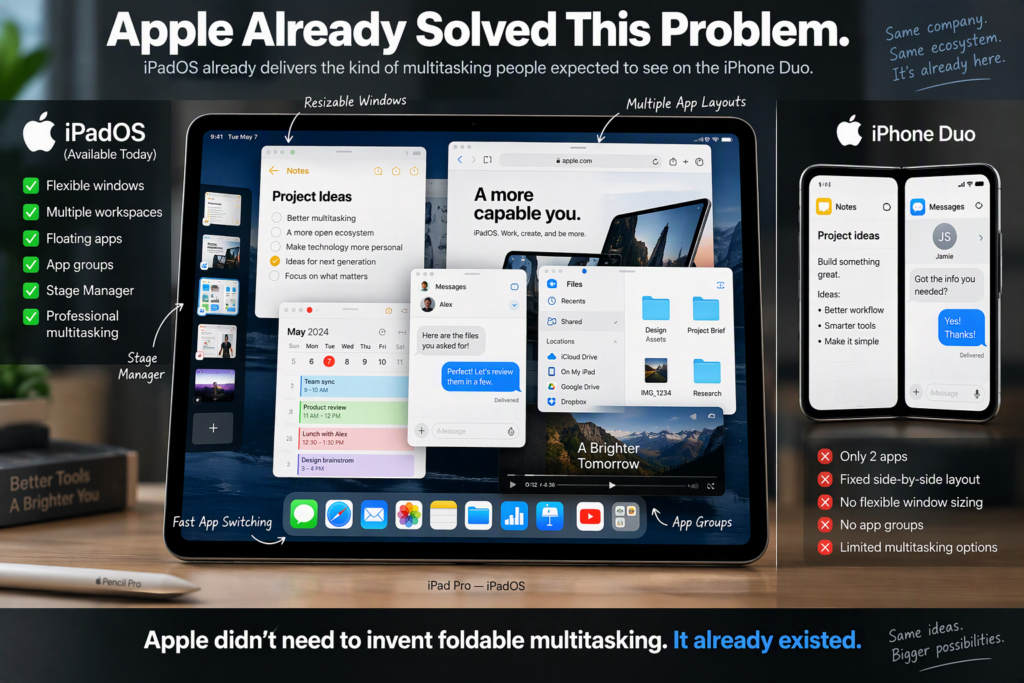
Even on older iPads, users can create numerous app combinations, resize windows, maintain multiple workspaces, and switch between tasks almost instantly. In many situations, an iPad offers more flexibility than Apple’s newest foldable. My own iPad regularly ends up with dozens of app layouts and window combinations. In fact, the bigger challenge is often remembering to clean up all the multitasking groups afterward. That’s how flexible iPadOS has become.
That’s what makes the Duo so confusing. The company didn’t need to invent a multitasking system from scratch. It already had one.
Final Thoughts
A cracked display is a defect.
A wasted display is a design decision.
Critics often compare the Duo to competing foldables and conclude that it loses the multitasking battle. I see it a little differently. The Duo actually succeeds at making two-app workflows easier. It is undeniably more convenient than a traditional iPhone when you need information from two apps at once.
But the disappointment comes from what could have been. I was certain Apple would finally put out a product even I would buy–especially since I am mourning the loss of OnePlus in the US and may never see a OnePlus Open 2 come to fruition.
Apple has years of foldable competition to study. It has iPadOS as a blueprint. It has some of the industry’s most powerful mobile hardware. And yet, when unfolded, the Duo often feels less like a foldable computer and more like a bigger iPhone.
If Apple wants the Duo to compete with the best foldables on the market, future software updates need to do more than fix bugs. They need to answer a much bigger question: What is the point of carrying a folding tablet in your pocket if the software treats it like an ordinary iPhone?