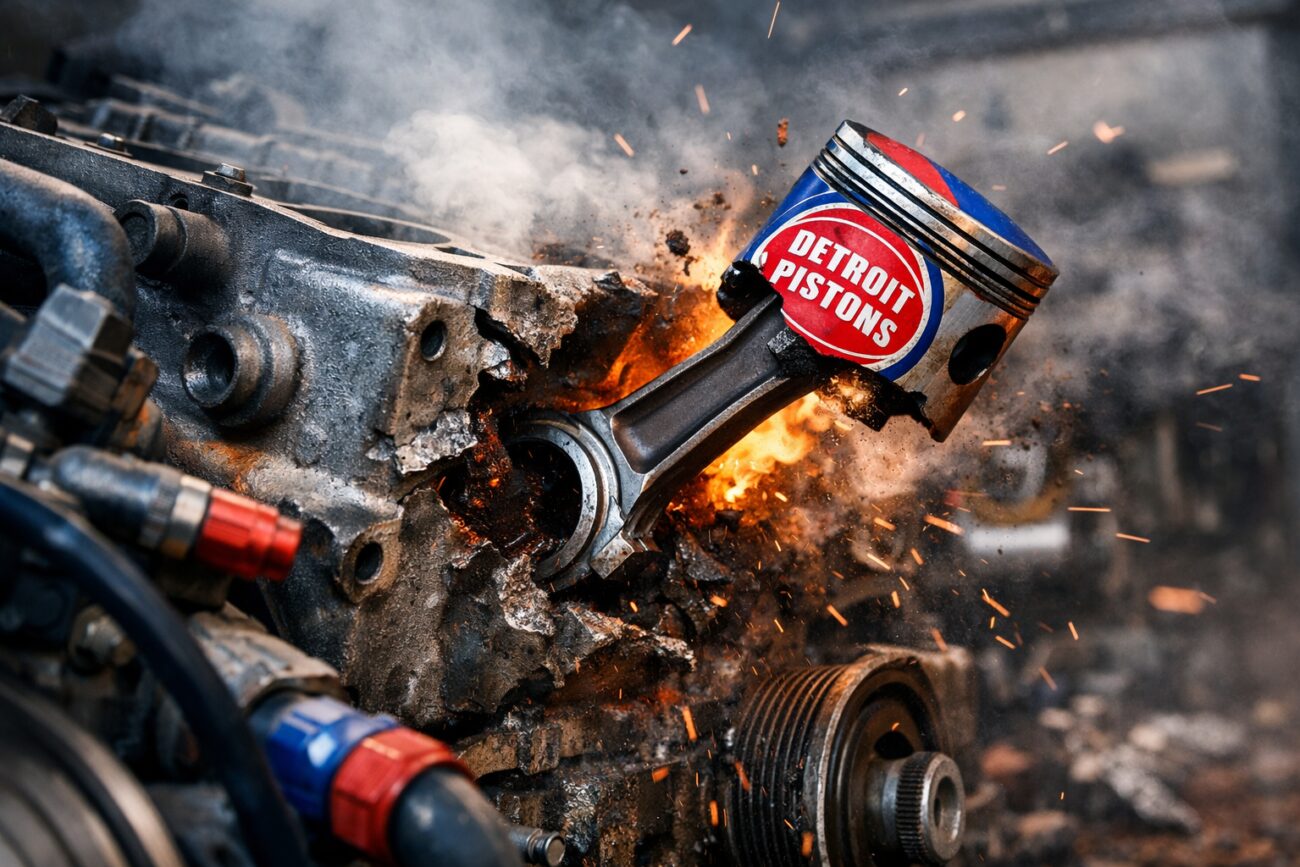
The Detroit Pistons delivered the kind of season that makes both petroheads and basketball fans lean in with the same hopeful squint—that moment when everything sounds right, the revs are smooth, the timing is crisp, and the stars glow like freshly‑gapped spark plugs. For months, Detroit didn’t just run hot; they ran supercar hot, burning with the intensity of a magnesium flare and firing off bursts of brilliance like a dragster hitting 10,000 horsepower for a quarter‑mile. They were the NBA’s equivalent of a top‑fuel monster: spectacular, violent, mesmerizing, and absolutely not built for longevity. Their offense fired clean, their defense held pressure, and the roster meshed like a well‑oiled valvetrain, giving fans the illusion that this machine might actually hold together through the postseason. But drag engines aren’t designed for endurance—they’re built for one perfect run, not a seven‑game grind—and somewhere between the final week of the regular season and the opening tip of the playoffs, Detroit’s engine crossed that invisible line between “running hot” and “running doomed.”
When the postseason hit, the Pistons experienced the basketball equivalent of a connecting rod deciding it no longer wants to live inside the engine block. One moment they were cruising at 6,500 RPM, and the next they were ventilating the metaphorical block, throwing performance parts through the side like they were trying to escape a Michigan winter. Their stars, brilliant as they were, burned with the intensity of high‑compression race pistons—explosive, dazzling, and inevitably short‑lived under extreme load. A star that burns twice as bright burns half as long; a piston that fires twice as hard blows through the block by mid‑April. Detroit’s regular season was the fireworks show, the dyno pull, the quarter‑mile pass that makes the crowd scream. The playoffs, unfortunately, were the smoke cloud afterward—the moment when the hood lifts, the engine bay hisses, and everyone realizes the spectacle came at a cost.
The good news is that engines that fail spectacularly are often the ones with the most potential. You don’t junk a block because it ventilated itself; you blueprint it, reinforce it, and come back with stronger rods, better bearings, and a tune that won’t melt the pistons by Game 82. Detroit has the parts—they just need the right torque specs, the right timing, and the discipline to build something that can not only shock the league from October to April but also survive the brutal load of postseason basketball. If they can turn this catastrophic failure into a proper rebuild, the next time this engine fires up, it might not just burn bright—it might actually last long enough to matter.
Detroit Pistons Shot Through the Block
(When a Stellar Season Burns Bright… and Burns Out)