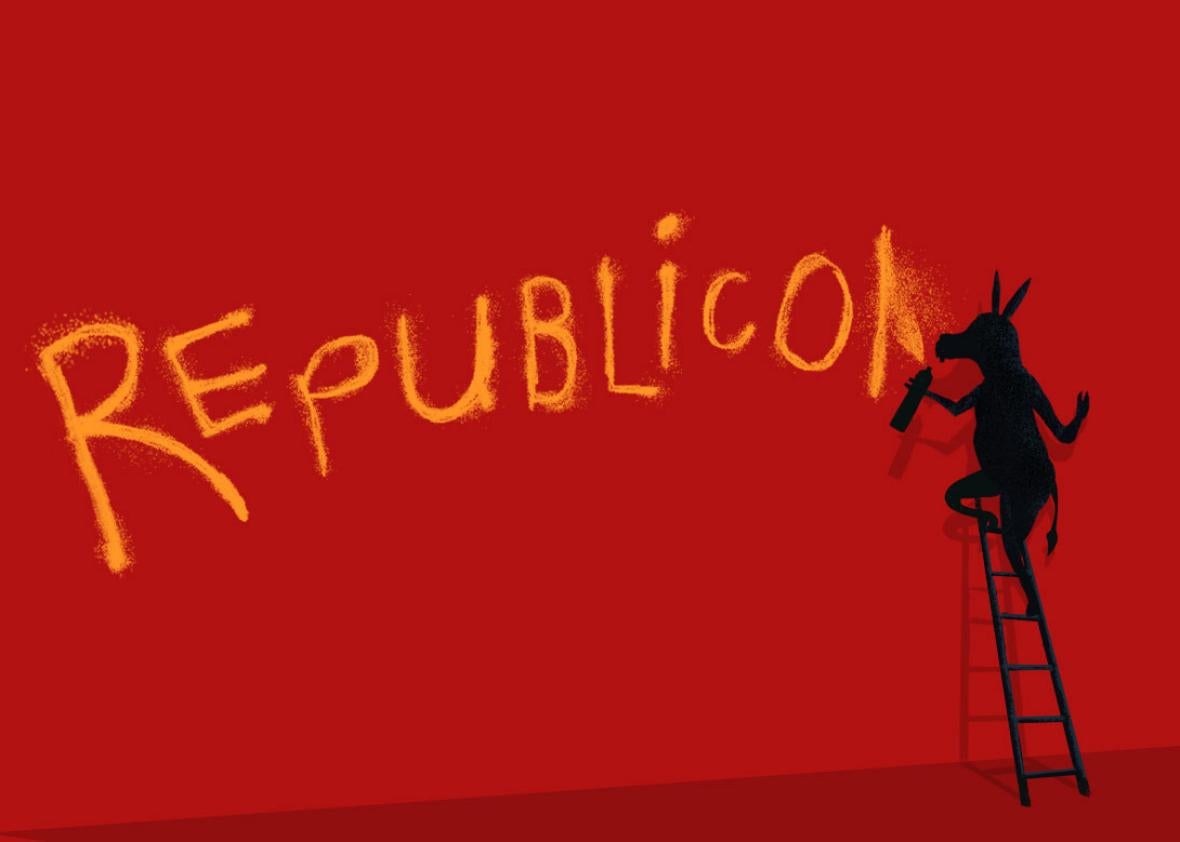
Republicons have spent decades branding themselves as the party of “law and order,” the tough‑on‑crime defenders of police, justice, and moral clarity. But since Trump’s first term, that branding has collapsed under the weight of their own actions. The party that once claimed to stand with law enforcement has increasingly aligned itself with people who attack law enforcement, undermine institutions, and normalize political violence. January 6 was the clearest turning point, when “Back the Blue” suddenly became “Beat the Blue,” and many Republicon leaders either excused, minimized, or outright supported the attackers. Trump himself has repeatedly praised Jan. 6 defendants as “patriots,” “warriors,” and “hostages,” which is not the language of a leader committed to law and order; it is the language of someone encouraging contempt for the rule of law.
The Pattern Began Long Before January 6
This pattern didn’t begin on January 6. It was the culmination of years of rhetoric encouraging supporters to view violence as a legitimate political tool. Trump’s first‑term Department of Justice repeatedly pursued politically motivated investigations that collapsed due to lack of evidence, with former DOJ officials and inspector‑general reports documenting how cases were pushed without probable cause, how prosecutors were pressured to target Trump’s perceived enemies, and how the department often operated backwards: decide the target first, then try to invent a crime later. This is not “tough on crime.” It is the erosion of justice itself.
Crime Trends During Trump’s First Term
Crime trends during Trump’s first term reflect a country destabilized by political polarization, social upheaval, and leadership that thrived on division. Violent crime remained relatively stable from 2017 to 2019, but in 2020 the United States saw a historic spike in homicides — roughly a 29% increase, the largest single‑year rise ever recorded by the FBI. Researchers attribute this to multiple factors, including pandemic instability and economic shock, but the spike occurred under Trump’s presidency, and his administration’s rhetoric about “civil war,” “enemy of the people,” and “liberate” states did nothing to calm the situation.
Hate Crimes Surge in the First Term
Hate‑crime data during Trump’s first term shows an even clearer pattern. FBI statistics documented a four‑year rise in hate crimes from 2017 through 2020, with 2017 seeing a 17% increase — the largest jump in a decade — followed by continued increases each year. Race‑based hate crimes rose, anti‑Asian hate crimes rose, and federal agencies including the Department of Homeland Security repeatedly warned that white supremacist violence was the most persistent and lethal domestic threat during Trump’s presidency. Anti‑LGBTQ hate crimes also increased, with 2020 marking the highest number of anti‑transgender hate‑crime incidents ever recorded at that time. The Human Rights Campaign documented record levels of fatal violence against transgender Americans, especially Black trans women, and noted that political rhetoric targeting LGBTQ people correlated with increased harassment and threats. Trump’s first‑term policies — from banning transgender people from military service to rolling back nondiscrimination protections in health care — created a climate where hostility was not just socially tolerated but politically validated.
Escalation in Trump’s Second Term
Now, in Trump’s ongoing second term, the data shows that these trends have not only continued but intensified. The FBI’s most recent hate‑crime report (2023 data, released in late 2024) shows another increase in reported hate‑crime incidents nationwide, with anti‑LGBTQ hate crimes rising again and anti‑transgender hate crimes reaching a new record high. Civil‑rights organizations including the ADL and HRC have noted that the political climate since Trump returned to office has been even more hostile, with a surge in extremist activity, increased threats against marginalized communities, and a measurable rise in harassment targeting LGBTQ people. DHS’s 2024 and 2025 threat assessments continue to identify white supremacist violence as the top domestic threat, and analysts have pointed out that political messaging from the Trump administration — especially messaging targeting transgender Americans — has contributed to a climate where hate‑motivated violence is more likely.
Crime Trends in the Second Term
Crime trends during the second term also reflect ongoing instability. While violent crime nationally began declining in 2022 and 2023, the FBI’s preliminary 2024 data shows uneven patterns, with some regions experiencing increases in aggravated assaults and hate‑motivated violence even as homicides declined. Researchers note that political polarization, online radicalization, and targeted hostility toward LGBTQ and racial minorities remain significant drivers of violence. The Trump administration’s continued efforts to demonize transgender people — including attempts to restrict gender‑affirming care, limit civil‑rights protections, and elevate officials who openly attack LGBTQ communities — have coincided with measurable increases in threats and violence directed at queer and trans Americans.
The Bottom Line
The bottom line is that the Republicon claim to “law and order” has become a hollow slogan. Their defense of Jan. 6 attackers, Trump’s praise of political violence, documented DOJ misconduct, multi‑year rises in hate crimes, record spikes in anti‑LGBTQ and anti‑trans violence, and a policy environment that encourages stigma and hostility all point to a party that has shifted from “tough on crime” to actively enabling it. The data from Trump’s first term showed the beginning of this trend, and the data from his ongoing second term shows that the continuation has been worse. This isn’t just political rhetoric — it’s a measurable pattern reflected in federal crime statistics, civil‑rights reporting, and national security assessments.